Camera On, Camera Off, Camera 'Oh No My Wi-Fi': The Ruthless Hierarchy of Zoom Etiquette
At some point between 2020 and right now, video calls stopped being a novelty and became a full-contact social sport. We didn't sign anything. There was no orientation. And yet somehow, every person with a laptop and a Slack account absorbed an elaborate, unspoken rulebook about what is and is not acceptable on a video call — and they enforce it with the quiet, ruthless energy of a homeowners association.
Welcome to the invisible constitution of Zoom culture. Pull up a chair. Or don't. We literally cannot see you.
Tier One: The Paragons of Video Call Virtue
At the very top of the acceptability pyramid sit the people who have their camera on, their background tastefully neutral (a bookshelf, a blank wall, a plant that is definitely real), their lighting soft but present, and their audio crisp. These people are either extremely professional or they simply have nothing to hide. Either way, the rest of the call respects them deeply and also finds them slightly exhausting.
Also in this tier: the person who gives a brief, cheerful wave when they join and then mutes themselves immediately. This is the video call equivalent of holding the door open for a stranger. It costs nothing. It signals everything.
Tier Two: Perfectly Acceptable, Slightly Chaotic
The blurred background crowd lives here. And look — nobody is judging you for blurring your apartment. That's the deal. Zoom gave us blur specifically so we wouldn't have to explain the pile of Amazon boxes or the roommate who refuses to wear a shirt before noon. The blur says: I am present. I am professional. What is behind me is none of your business and I will die before it becomes your business.
Also acceptable: the person who joins five minutes late, apologizes sincerely, and turns their camera on for the rest of the meeting. Redemption arc. The group accepts you.
Slightly lower in this tier but still defensible: the person whose camera is on but who is clearly also eating. If it's a long call and you are visibly trying to be discreet about it — eating off screen, chewing with the energy of someone defusing a bomb — you get a pass. We've all been there.
Tier Three: The Gray Zone (We Have Questions)
Here we find the strategic technical failure. You know the one. The call starts, the agenda is something you'd rather not be present for, and then — oh no — your camera just won't seem to turn on today. Mysterious. Tragic. Completely unverifiable.
Is this acceptable? Statistically, yes. Is it believed? Absolutely not. Everyone on the call knows. The meeting organizer knows. Your camera knows. But the social contract holds because confronting it would be weirder than just letting it happen.
Also in the gray zone: the person who has their camera on but is clearly doing something else. Not subtly. Their eyes are moving. There is typing that does not correspond to anything being said. They nod at the wrong moments. This is a haunting. You are being haunted by someone who is technically present.
Tier Four: Bold Choices With Consequences
The virtual background that is too much lives here. A beach? Fine. A mountain? Sure. A scene from The Office that only one person on the call is going to laugh at? You've made this about you, and you knew what you were doing. Respect, honestly, but also: why.
The person who joins from their car gets their own sub-tier. If you are in a parking lot and you turn your camera on, the entire call is now about the fact that you are in a parking lot. No one will retain any information from this meeting. You have become the meeting.
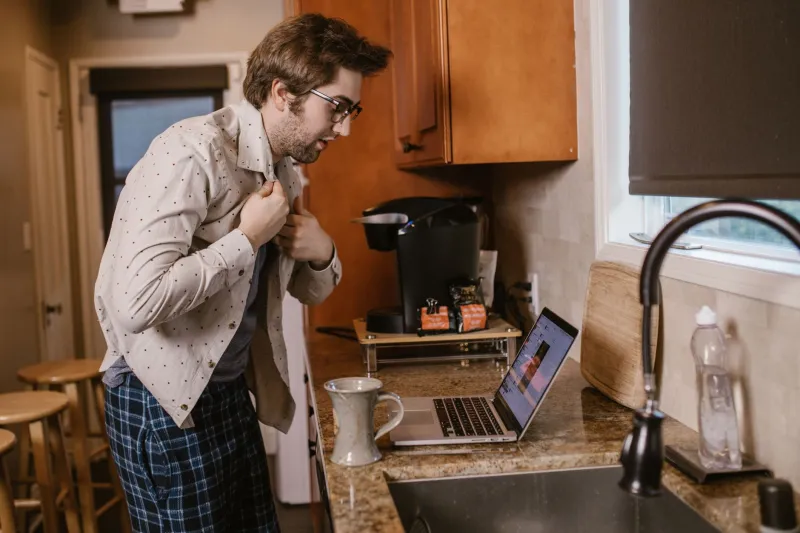
And then there's the accidental reveal — the camera comes on before you're ready, and for one terrible second, the group sees your ceiling, your dog investigating the laptop, or a household member wandering through in a bathrobe. This is not a failure of etiquette. This is just life, and the call must never speak of it again.
Tier Five: We Need to Talk
Bottom of the hierarchy. Reserved for the rare but unforgettable offenses.
The person who has their camera on but is clearly lying down. Not sick-lying-down. Comfortable-lying-down. Pillow and everything. This is a power move so extreme it wraps back around to being kind of impressive.
The person whose camera is pointed directly at a window so that they appear as a featureless silhouette backlit by the sun. You look like a witness in a true crime documentary. Is that on purpose? Are you okay?
And finally, the category that transcends judgment: the person who turns their camera off mid-sentence while they're talking. Not at the end of a thought. Not during someone else's turn. While speaking. The call goes silent. Their voice continues from the void. No one recovers.
Which Professions Have the Weirdest Camera Politics?
Teachers and professors have developed a system so layered it could be a dissertation topic. Students' cameras off is the norm, but the teacher's camera on is non-negotiable, which means educators have spent years performing engagement into an empty black grid of rectangles. It's theater. Brave, underpaid theater.
Legal professionals are on the opposite end — camera etiquette in law firms is so rigid that some partners have reportedly required camera-on policies for all internal calls, which is the professional equivalent of making everyone stand at attention. Respect the hierarchy or get off the Zoom.
Creatives — designers, writers, marketing teams — tend to operate in the most chaotic camera culture of all. Cameras optional, snacks visible, pets welcome, someone is definitely in a hoodie, and the call will somehow still run 40 minutes over time.
Tech companies invented the camera-off culture and they will die defending it. Your camera being off in a standup is not a statement. It is simply the way things are.
The Actual Rule Underneath All the Rules
Here's the thing: every camera decision you make on a video call is a tiny, low-stakes social negotiation. You're reading the room — or the grid of thumbnails — and making a call about how present you need to be, how much you trust the group, and honestly, whether you've had enough coffee to be perceived today.
The unspoken contract isn't really about professionalism. It's about mutual pretending. We all agree to act like this is normal, like staring at tiled rectangles of our coworkers' faces is a perfectly natural way to conduct human business. And in exchange, we extend grace to the blurred backgrounds, the strategic connection issues, and the occasional dog that refuses to stay off camera.
Qoopie gets it. Weird has a Wi-Fi signal, and apparently, so does the entire invisible rulebook of modern work life. Turn your camera on. Or don't. We'll all silently judge either way and then never bring it up.
That's the contract.